
Dengue hits Delhi, and I lost my first tooth
Of my thirty-two teeth, one is now a crater in my jaw
as if it was envious of the Icelandic volcano
with the tongue-twisting name Eyjafjallajökull
Traveling in India is just like a kaleidoscope picture: you shake it, and you don’t know what will come out. So first, we have landed in Kashmir, in the midst of Ramadan and riots, with more army on the streets of Srinagar than I have remembered from martial law in Poland. And then we have changed an environment diametrically moving towards Buddhism: the Dalai Lama and these vibes.
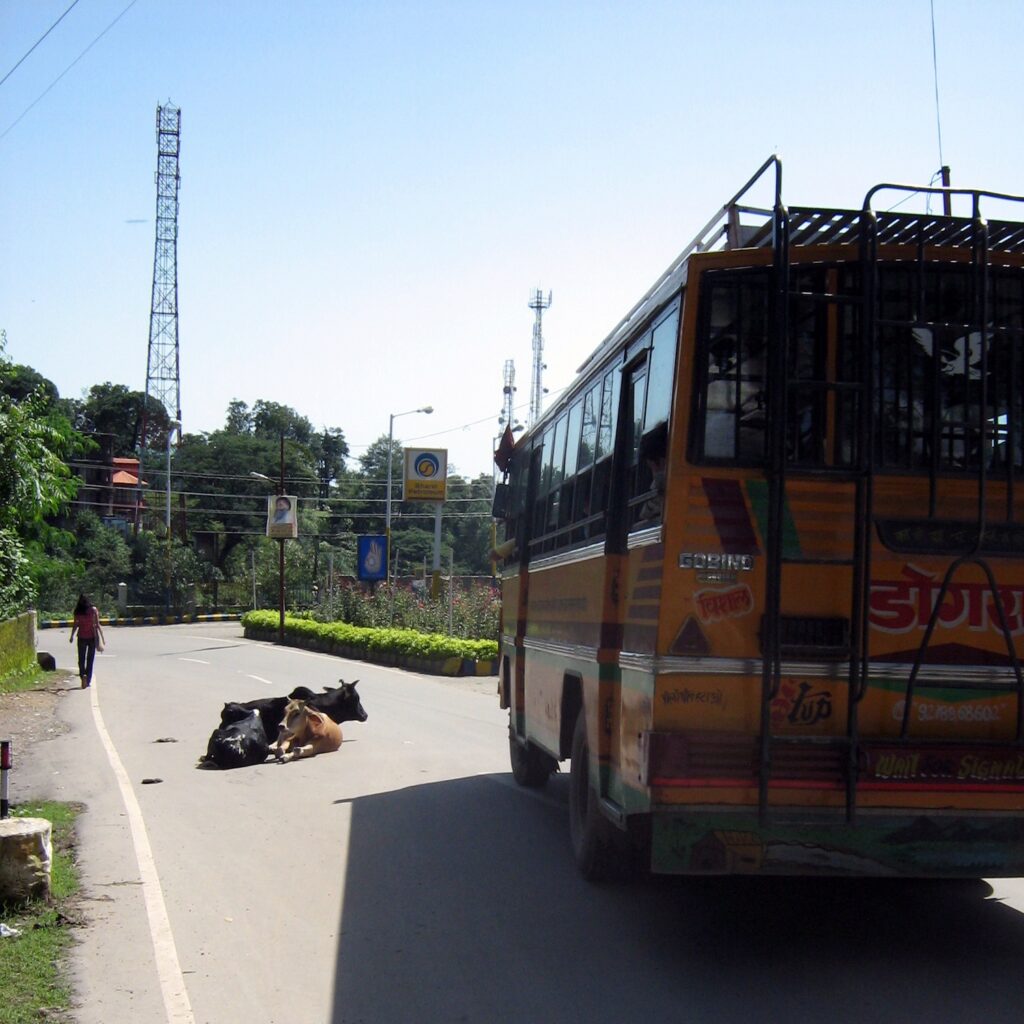
In McLeod Ganj, darkness engulfs the day suddenly, somewhere around six in the afternoon. There is no dusk, just as there is no dawn. This may be why people here are more inclined to intense colors and emotions. Without distinguishing half-shadows. And light and dark are instrumental in this story.
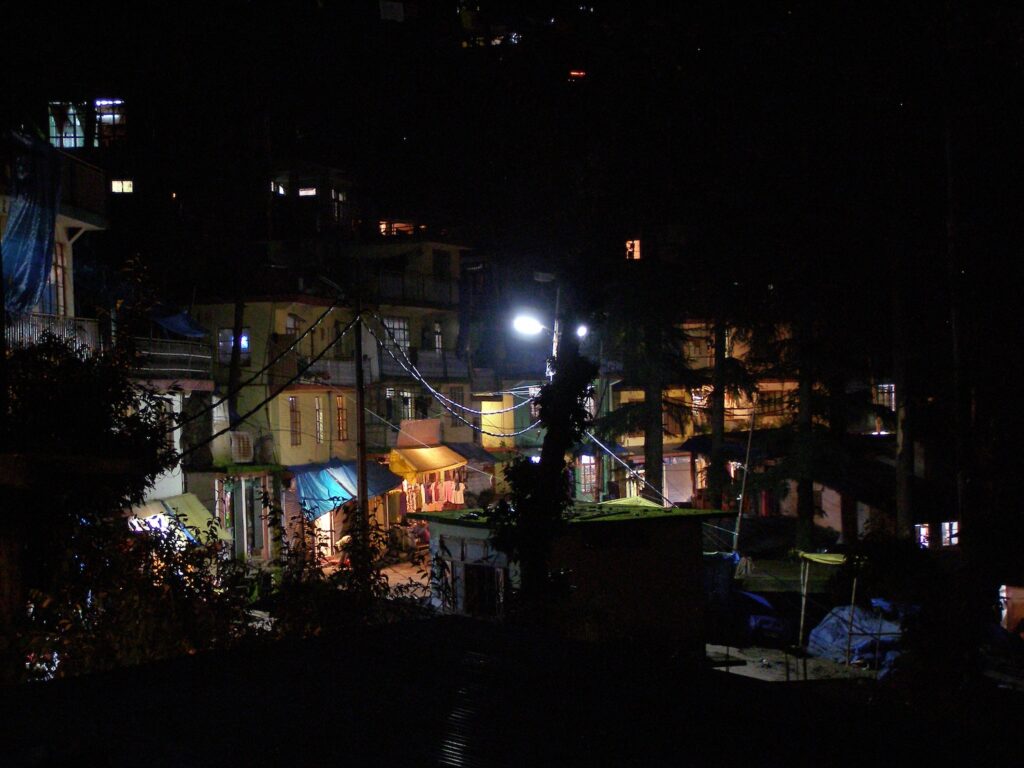
We have been in McLeod Ganj. We have bought tickets for the night bus. To Shimla. De Lux. The tickets cost ridiculously little. We have recalculated the change to ensure the Himachal Pradesh Transport Company representative hasn’t miscalculated to the bus company’s disadvantage. Still, no: everything is correct down to the last rupee. So we have the tickets. The bus leaves from nearby Dharamsala.
It’s already dark by the time we have reached the main square in McLeod Ganj with our backpacks. The rickshaw drivers have already gone home, the tuk-tuks have also dispersed, and the square is now occupied by taxis. We quickly hit the market and leave.
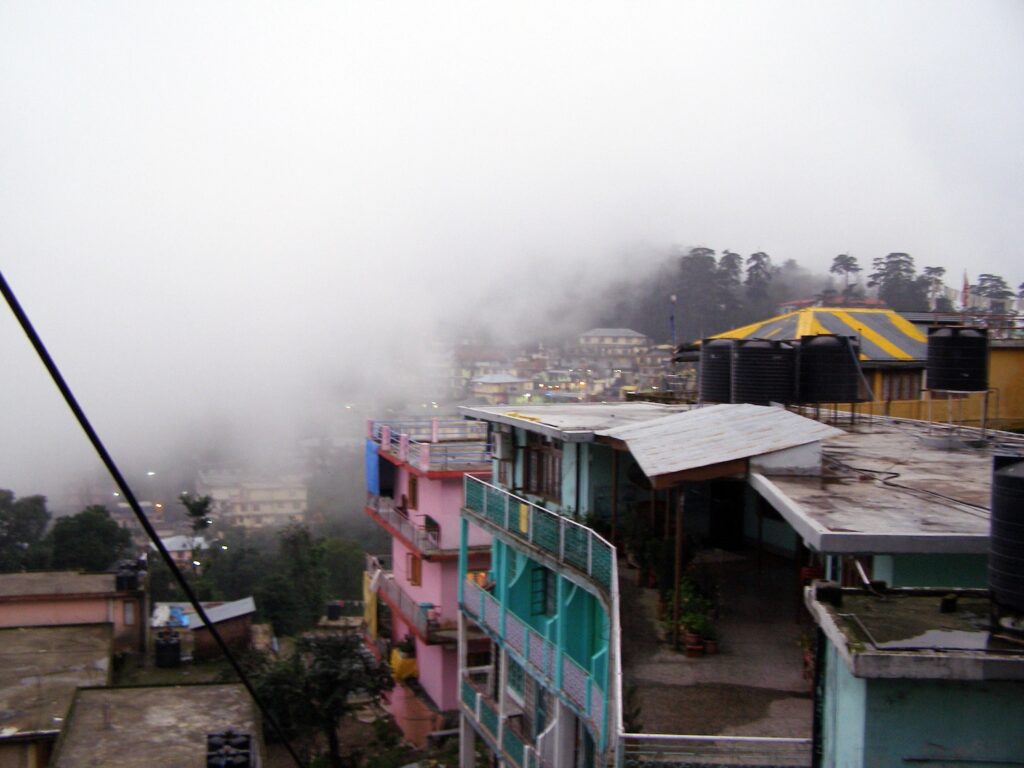
Fog everywhere
I ponder if our driver is driving because he can see the road or remembers how it runs. The route is a winding serpentine descending sharply downhill in black tar seasoned with a fair hint of milk mist.
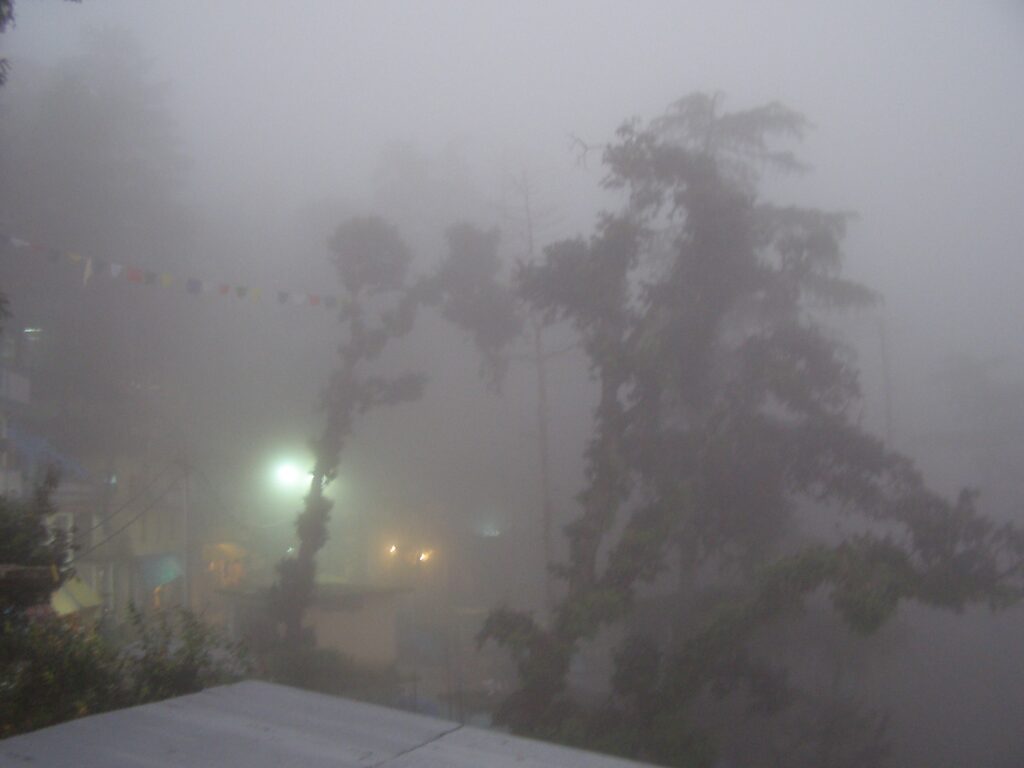
We have reached Dharamsala. That’s what we think, only…. well, there’s no electricity again. In places, the light of the distant houses breaks through the fog; every now and then, headlamps sweep the glare of some passer-by or perhaps an apparition. The phosphorescent eyes of cows, dogs, goats and monkeys resemble scattered stars in the night sky. We have not recognised our surroundings.
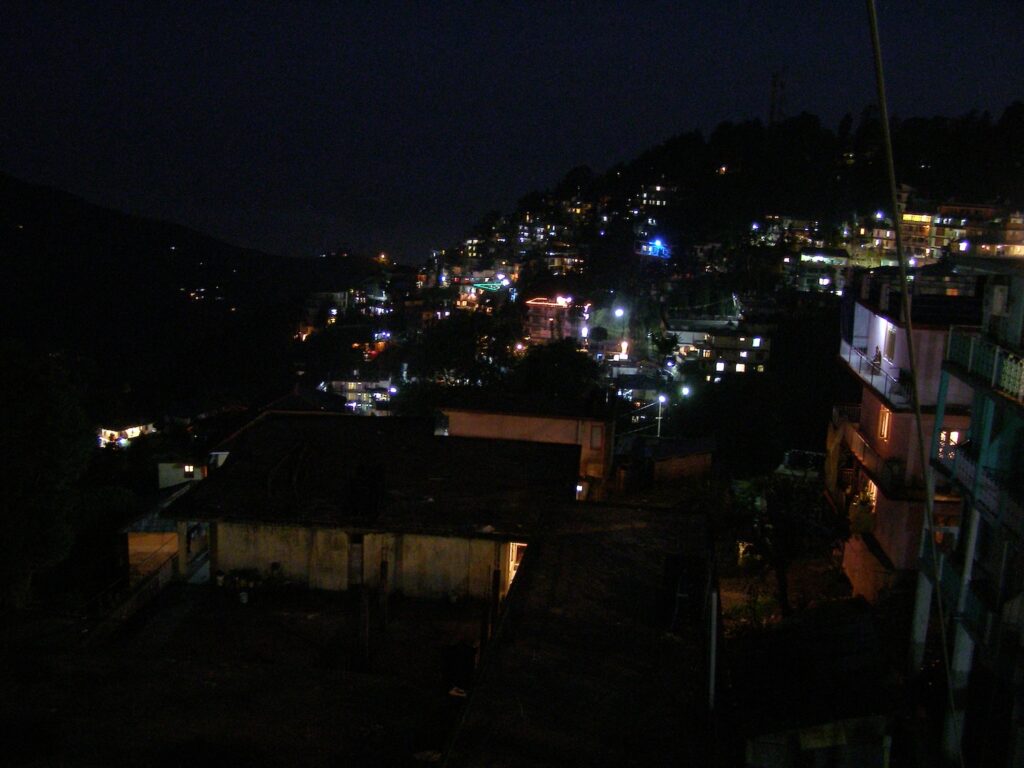
“No power, no problem.” The driver says, and at the same time, he smiles disarmingly. After a while, we stop. Confused, we have tried to penetrate the darkness. We have heard a firm “The end.”
“Is this the bus station?” I ask.
“Yes, there.” And he waves his hand in an indefinite direction. We have walked straight out into the hustle and bustle. Dogs lie next to piles of rubbish and watch us closely. Somewhere, the locals are in a hurry. Horns honking, engines whirring. The unmistakable stink-fragrance: exhaust fumes, garbage, excrement, incense and mist, all in a high concentration of moisture heated by the daytime sun. The air seals our lungs up. We have paid and taken our backpacks.
We have stood between buses. Inscriptions in an unknown alphabet tell us which direction we can go. I could embroider oriental Hindi letters on a napkin as decoration, but I cannot read them.
We have returned to a state of illiteracy
Suddenly, a truck has passed us with a loud honking sound. We have jumped off. There are only dogs left around us, but after all, we won’t ask them for directions. Darkness, fog, huge buses grinning at us; every now and then, a passing car lights up the area, and then the mist thickens even more and takes us away. In a moment, demons emerge from the darkness. And so we stay here for ever and ever…
Intuitively, we have gone in the direction we think the driver has shown us. Narrow passages between rickety vehicles. I wonder if this is what we will be driving all night. De Lux alá India. Maybe it’s better not to think. We, not religious, have recited all the known hail-marys, angel-of-gods and our-fathers. I can already see with my imagination’s eyes how the speeding bus knocks us down like a bowling ball.
And then, from behind the buses, we have seen an afterglow. And in its glare, a canopy with barracks, benches, people and the light of mobile phones. Long live mobile telephony! We have walked closer. An Indian man with a protruding top tooth runs up to us, and I wonder if this one remaining tooth is not bothering him. Perhaps it would be easier for him if he didn’t have one at all. An association arises: I lost one tooth; he only has one.
We have guessed more than understand that he is asking us about our destination.” Shimla.” I reply.
“Shimla, not yet. Delhi now.” We hear an answer. And then he says, as he leaves: “Wait here!”
We have been early, so we have observed life at the station. Here, everything has its place and our one-toothed manager rules. He calls out in drag:
“Dilhe, Dilhe, Dheliii!” He has no teeth, but he has a voice. He walks up to the travelers, takes their luggage, packs it, and the rupees pass from hand to hand.
And clarity emerges. The surroundings take on real shapes. People move more nimbly as if the lantern’s light has energized them. The efficiently packed bus sets off for Delhi.
A child approaches us, a boy about six years old with a bald shaved skull with a small lock of hair at the tip. He limps and has a deformed one arm; he is gurgling something; we have understood nothing; people around have been looking indifferently.
We quickly learn that poverty, like war or disease, is a natural condition ascribed to our fate or human nature
More travelers have been appearing. The boy walks away, bobbing clumsily, and accosts another newcomer; an impatient Tibetan gives him some change. A second boy, black-haired and black-eyed, appears immediately. He takes his companion’s money, counts the loose change pulled from his torn trousers, and together, they run to the kiosk to buy samosas. The triangular pieces of dough with a spicy filling are quickly lost in the children’s mouths. Afterwards, the boys drink water from a pump and run around the bus stop, and the man with one tooth shouts something to them; they begin to ape him. The clerk at the ticket office, who has stepped out of his cramped cubicle for a moment to stretch his bones, laughs at them and hands out nudges. The carefree romp draws the attention of the people for a moment.
Another bus pulls up. And again, we hear the one-toothed anon:
“Manali, Manali, Manaaaliii…”
No one pays attention to the children anymore, and they pull out a bundle from under the bench, a pile of old rags. They place them on a concrete pedestal, which during the day serves as a bench, seat, table, or whatever you want. They make their bed, go to the pump and, like young foals, pushing and teasing, wash their faces, ears, teeth and legs. And then they make a race to their lair. They lie curled up in a ball and keep mumbling. They’ll probably fall asleep soon… the station kids.
I sit and watch; then we hear our:
“Shimla, Shimla, Shimlaaa!”